Start planning your next pentest project
by answering a few questions about your needs
External pentesting
External network penetration testing
The external network is the part of your organization that is accessible from the internet. This includes cloud-based assets such as web servers, email servers, and VPN gateways. Our external network penetration testing service simulates real-world attacks by attempting to breach your organization from the public internet.
Internal pentesting
Internal network penetration testing
Internal infrastructure refers to the network and systems within your organization that support your operations. These typically include on-premise systems, such as file servers, databases, workstations, and internal applications. During an internal infrastructure test, we aim to assess your organization’s vulnerability to insider attacks or attackers who have gained access to your network.
Web app pentesting
Web application penetration testing
API pentesting
Download the 2025 edition of our penetration testing buyer's guide
Learn everything you need to know about penetration testing to conduct successful pentesting projects and make informed decisions in your upcoming cybersecurity assessments.
- A real pentest project in action, the process and the results
- The different types of penetration tests and how they compare
- The use cases of vulnerability scans VS. manual tests
- The industry's average cost for a typical project
- 20 key questions to ask your prospective provider
Achieve streamlined compliance
Our penetration tests help your organization achieve compliance with various cybersecurity standards and third-party requirements as efficiently as possible by providing an independent confirmation that you’ve identified and successfully mitigated your most critical cybersecurity risks.
- ISO/IEC 27001 Information Security Management
- SOC 2 Type I & Type II
- PCI-DSS for the Payment Card Industry
- HIPAA For Health Care
- GDPR General Data Protection Regulation
Download our external pentesting case study
See our external penetration testing services in action and discover how they can help secure your public-facing network perimeter from modern cyber threats and exploits.
Download our Web app pentesting case study
See our Web App penetration testing services in action and discover how they can help secure your applications / APIs from modern cyber threats and exploits.
The modern approach to launch and manage pentest projects
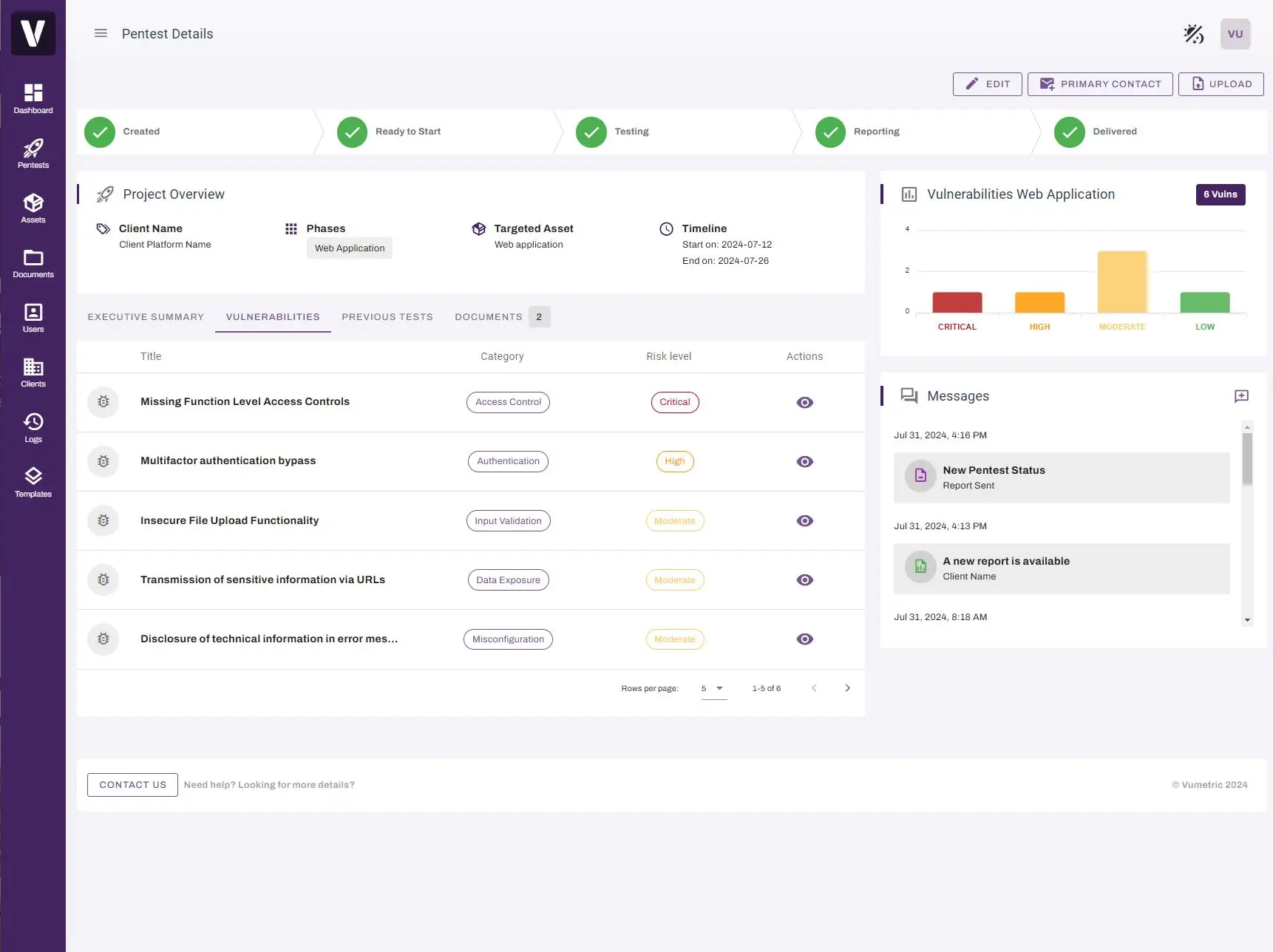
Our reputed project management and consistent reporting has long been powered by our own internal testing platform.
We’ve now included a client-facing interface to help streamline your projects and remove potential delays in planning / scoping by providing self-service capabilities.
Get actionable cybersecurity improvements
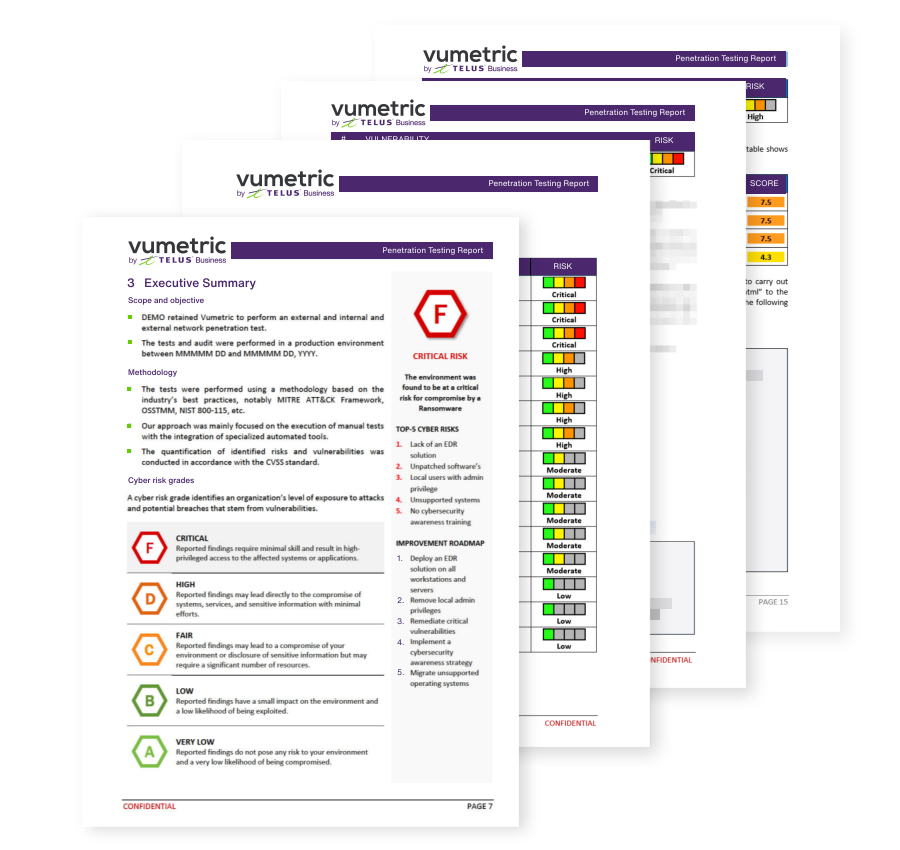
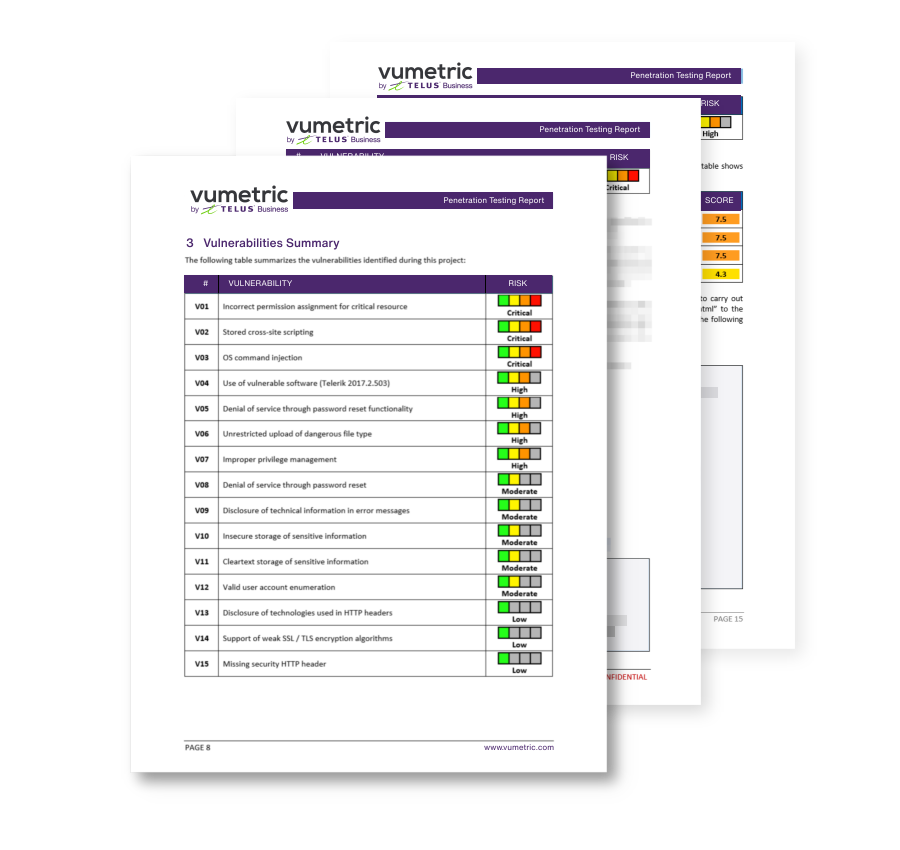
Our pentest reports are reputed by organizations for delivering concise information that helps fix your vulnerabilities, improve your security posture and meet compliance requirements. Each vulnerability we identify is manually exploited, measured and documented by an experienced specialist to ensure you fully understand its business impact and how to fix it.
Read our latest reviews to discover how our clients talk about their experience with our team:
“ They had friendly staff and realistic down-to-earth recommendations ”
Mark D, IT Director
Mid-Market
“ I'm impressed by the common sense and technical skills of the team. ”
Carl P, Director of Infrastructure & Security
Mid-Market
“ The team is extremely knowledgeable in what they do ”
Wes S, IT Manager
Enterprise
“ Amazing team of experienced cybersecurity professionals! ”
VP, Research and Development
Mid-Market
Frequently asked questions
Didn’t find the answer to your questions?
How does penetration testing work?
A penetration test is a simulated hacking attempt that identifies opportunities for real hackers to break through your defences and perform various malicious acts. It generally leverages tools used by hackers and various professional methodologies to replicate the steps that modern hackers would take to intrude into your IT systems.
A pentest attempts to exploit your vulnerabilities to determine their potential impact, should they be used in a real hacking scenario. They provide a list of vulnerabilities with their respective level of severity, as well as technical recommendations to help your team apply corrective measures and focus on the most critical vulnerabilities.
These services allow your organization to answer the following questions, among several others:
- Can a hacker gain access to any sensitive information?
- Can a hacker hijack my technologies for any malicious acts?
- Could a malware infection spread through the network?
- Can an attacker escalate access to an administrative user?
When should I conduct a penetration test?
There are many contexts in which a penetration test should be performed.
Here are some common use cases for a pentest:
- As part of the development cycle of an application. (To test the security of a new feature/app)
- To comply with security requirements. (3rd-parties, PCI, ISO27001, etc.)
- To secure sensitive data from exfiltration.
- To prevent infections by malware. (Ransomware, spyware, etc.)
- To prevent disruptive cyberattacks. (Such as denial of service)
- As part of a cybersecurity risk management strategy.
All businesses are advised to conduct a penetration test at least once a year, as well as after any significant upgrades or modifications to the company network. Given the rapid rate at which new exploits are discovered, we generally recommend that quarterly tests are performed.
How long does a penetration testing project generally last?
The time required to successfully execute a penetration test depends on the scope and type of test. Most penetration tests can be performed within a couple of days, but some can span over several weeks, sometimes even months depending on the complexity of the project.
What is the difference between a pentest and a vulnerability scan?
Vulnerability assessments and penetration tests are the most common techniques to uncover and fix cybersecurity flaws within your technologies. While some similarities exist between the two, they are often misinterpreted as the same thing although they yield very different degrees of analysis.
Vulnerability scanners are generally used by IT staff in order to check network infrastructures for known vulnerabilities that may have been introduced during their implementation. Penetration tests, by contrast, identifies both well-documented vulnerabilities, as well as those that have never been seen before, while providing evidence of their potential impact on your company.
Learn more about the main differences between vulnerability assessments and pentests →
What is the difference between automated and manual pentests?
Similar to the previous point, automated tests (known as Vulnerability Scanners or Vulnerability Assessments), allow IT teams to identify potential misconfigurations and known vulnerabilities within the versions of their software, operating systems and technologies.
While automated tests are cost effective and require less expertise to be performed, they do not yield the same level of analysis and cannot identify complex vulnerabilities (Such as logic flaws in applications, or vulnerabilities in custom-built environments). Automated tests may also cause harm to your systems and pollute your databases, so its use should be limited, complementary to manual tests and should be performed by experienced professionals to limit their negative impact.
Manual tests, on the contrary, requires much more expertise and a deep understanding of various technological contexts. They allow your organization to contextualize their vulnerabilities and provide evidence of their potential impact on your company. They can identify even the most subtle vulnerabilities that could potentially have a critical impact, which automated tests cannot identify, causing as little harm as possible to your systems.