

AI / LLM penetration testing services
LLM penetration testing services designed to uncover and address vulnerabilities in applications that embed AI features, whether it’s a support chatbot, RAG assistants, autonomous agents or any other product where a language model has access to your data, tools or customers.
Our AI pentesting approach combines adversarial prompt engineering and manual exploitation of application business logic to expose the attack paths malicious actors could use to achieve unintended outcomes.
See a real LLM pentest project in action!
Request a quote for LLM pentesting

Manual and automated testing
Supported by industry standards
Real-world expertise
What is a LLM penetration test?
LLM penetration testing is a structured security assessment that finds how attackers can exploit large language models embedded in your applications for malicious outcomes. Unlike traditional vulnerability scanning, it requires active, hands-on testing by specialists who understand both offensive security and how LLMs behave under adversarial conditions.
During an LLM pentest, certified professionals actively attempt to manipulate model behavior, extract sensitive data, bypass content controls, abuse connected tools and APIs, and escalate access through the AI layer of your application to determine how your agents could be leveraged to compromise your cybersecurity.
Why LLM pentesting is critical for organizations
Chatbots, copilots, and agents with tool access are now handling customer data, executing actions, and making decisions your app was never scoped to touch. With development teams now shipping AI features faster than internal security teams can keep up with, these applications present a new set of risks that often falls beyond the scope of standard application security assessments.
If your organization has deployed or is building applications that integrate LLMs, you need to know where those systems can be manipulated, what data they can unintentionally expose, and how far an attacker could go once they find an attack path.
As your app’s attack surface increases expontentially, the scope of your pentest should adapt accordingly. From system instructions, prompt processing, guardrails, integrations and autonomous access to IT systems, the number of potential security gaps left untested has become significant and organizations need to assess how their agents could be turned against their own infrastructure for malicious purposes.
LLM exploits we test
Prompt injection & jailbreaking
Direct and indirect injection, instruction overrides, and attempts to bypass system prompts or safety guardrails.
Data & system prompt leakage
Whether the model can be coaxed into exposing confidential data, its own system prompt, or memorized training data.
Tool & function-calling abuse
Whether an attacker can manipulate the model into misusing connected tools, plugins, APIs, or agentic actions.
Access controls & multi-tenancy
Session handling and data isolation between users or tenants sharing the same AI application.
Output handling
How model output is consumed downstream, and whether it can be used for SQL injection or code execution.
Hosting & infrastructure
The APIs and hosting infrastructure serving the model, as well as resource-exhaustion / denial-of-service paths.

Receive clear and actionable results
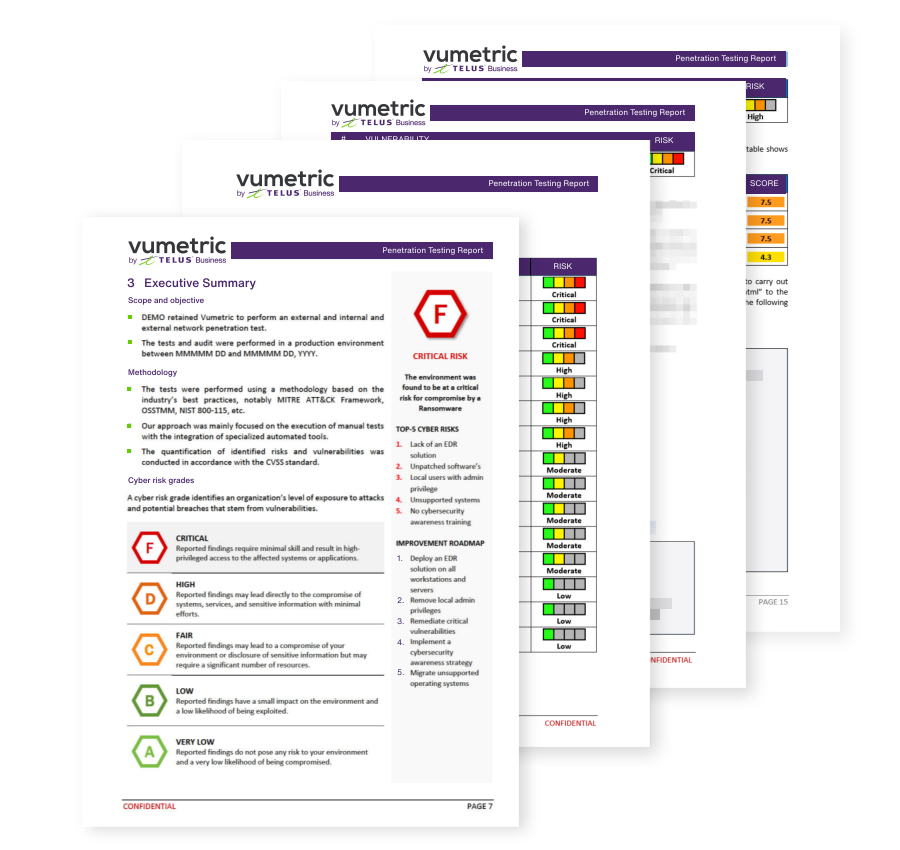
Our penetration reports deliver more than a simple export from a security tool. Each vulnerability is exploited, measured and documented by an experienced specialist to ensure you fully understand its business impact.
Each element of the report provides concise and relevant information that contributes significantly towards improving your security posture and meeting compliance requirements.
Deliverables will be shared both in PDF format and through an interactive Web dashboard on the Vumetric PTaaS platform so you can securely share findings across your team.
Executive summary
High level overview of your security posture, recommendations and risk management implications in a clear non-technical language.
Suited for non-technical stakeholders.
Vulnerabilities & recommendations
Vulnerabilities prioritized by risk level, including technical evidence (screenshots,
requests, etc.) and recommendations to fix each vulnerability.
Suited for your technical team.
Attestation
This document will allow you to meet compliance and regulatory reporting requirements efficiently and with minimal overhead.
Suited for third-parties (clients, auditors, etc).
LLM security testing compared to a traditional penetration test
A typical pentest project targets recurring patterns found in application logic to attempt manipulating functions in unexpected ways, often limited by the features served by the applications or their underlying technologies.
While AI agent security testing can also assess application-level vulnerabilities, it goes much further by leveraging the autonomous nature of these models to launch actions / make changes that shouldn’t be possible in normal circumstances, bypassing standard application security measures that weren’t designed to mitigate these risks.
LLM testing
Exploits probabilistic behaviors, reasoning, language parsing and prompt processing.-
Instruction-based guardrails as a first line of defense
-
Rogue agent sandbox escaping and lateral movement
-
Context interception and manipulation
-
Autonomous access to tools and data
-
Unrestricted MCP server access and capabilities
-
and more
Conventional pentesting
Exploits techncal vulnerabilities and business logic found in modern applications.-
Limited by enforced security measures at runtime
-
Cloud-hosting infiltration and lateral movement
-
User permissions escalation
-
Database query injections and remote code execution
-
Unrestricted API access and user calling rules
-
and more

Frequently asked questions
Didn’t find the answer to your questions?
What types of LLMs can you test?
We test any application that integrates a large language model, including customer-facing chatbots, internal knowledge assistants, RAG-based document retrieval systems, AI agents with tool access, LLM-powered APIs, and products with embedded AI features. We work with applications built on commercial APIs (OpenAI, Anthropic, Azure OpenAI, Google Vertex AI, AWS Bedrock) and self-hosted models.
Do you test the underlying model, or the application?
Our tests are focused primarily on the LLM integration within your application: From the integration layer, system prompt design, retrieval pipeline, tool integrations, output handling, and authorization logic. Our team is focused on identifying what an attacker can achieve against your deployed application using the access they would realistically have when interacting with your agents.
What access do you need to conduct the assessment?
We conduct projects according to your requirements to help meet your business objectives.
Our LLM pentests can be conducted from the following perspectives:
- Unauthenticated
- Unauthenticated with the ability to create an account
- Authenticated, but with limited access
- Authenticated with an admin user account
It’s highly recommended to conduct testing from the perspective that the majority of your users are accessing the app from to help identify and mitigate your most at-risk attack vectors.
Can this assessment help with compliance?
Frameworks including NIST AI RMF, SOC 2, and emerging AI-specific regulations increasingly expect organizations to assess AI-specific risks as part of their security programs.
While no major framework currently mandates LLM penetration testing explicitly, demonstrating proactive AI security assessment is increasingly expected in audits, enterprise procurement questionnaires, and insurance applications.
Our assessment will not only help demonstrate the current state of your security posture, but can also provide evidence of successful mitigations through remediation testing following your implementation of our recommended corrective measures.